
Machine translation — the Estonian version is authoritative.
What is a thread insert and what is it used for?
What is a thread insert?
A thread insert is a spiral-shaped metal "spring" that is installed into a pre-tapped hole to create a stronger internal thread for an externally threaded bolt.
Thread inserts are sometimes also called thread-repair springs, thread-repair fill springs or Helicoils (a popular colloquial name that is in fact nothing more than the registered trademark of the company that manufactures thread inserts).
What are thread inserts used for?
Thread inserts are typically used for two reasons:
- 1. To repair a broken thread.
- 2. To create a stronger thread in weaker materials such as aluminium, plastic and the like.
Most often they are used to strengthen threads in OEM castings and machined parts made from lighter and at the same time weaker materials — aluminium being the most common of these.
They are also available as a thread-repair kit together with an installation tool, a drill and a thread tap, which lets you quickly repair a thread or create a new one as needed. They are most widely used in the machine and automotive industries. They are very popular in the repair of used cars, where restoring threads generally turns out to be considerably cheaper than buying a new part.
How does a thread insert work?
When the thread wire is wound into a thread insert and installed into a tapped hole, it provides a permanent and wear-resistant thread in the base material that is generally 20% stronger than the original thread.
Thread inserts are made so that their diameter is larger than the hole they are threaded into, and they are compressed during installation. This allows the maximum contact surface with the tapped hole, fixing the thread insert permanently in place. The thread insert helps distribute the load evenly across the whole bolt and hole, making it stronger and more resistant to being pulled or twisted out. When a thread insert is used, the load and stress are distributed more evenly throughout the assembly.
The stress-concentration problems that usually occur on threads cut directly into the base material are thus eliminated. The thread insert adapts in size both radially and axially, based on any expansion or contraction within the base material.
Threads created directly in the material can typically cause:
- A limited contact point
- Poor flank contact between the bolt and the base thread
- Uneven distribution of the bolt load between the mated threads
- Failure of the threaded components under load (especially with aluminium and other weaker metals).
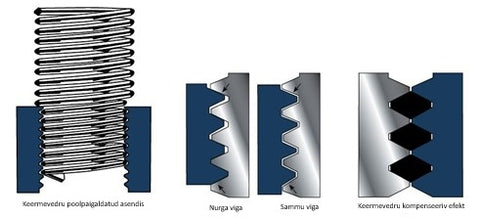
The diagram below graphically depicts the advantages of a thread insert compared with a conventional thread. In conventional threaded joints, over 75% of the load is placed on the first three threads of the joint. The thread insert on the left shows how the spring-like design makes it possible to convert shear load into the preferred "hoop stress" or radial load across the whole length of the insertion. This gives a much stronger thread than conventional drilling and tapping.
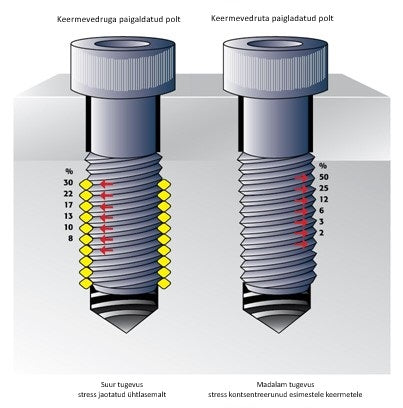
This solution allows engineers to choose a fastener based on the minimum strength of the bolt. Thanks to this, manufacturers can confidently use bolts of smaller diameter and shorter thread length even in weaker materials such as magnesium or aluminium alloys.
How do you install a thread insert?
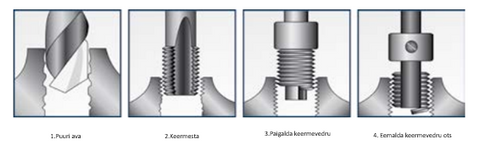
There are 4 simple steps to installing a thread insert.
- A hole of the correct diameter is drilled.
- The drilled hole is tapped with a special thread tap that matches the outer diameter of the thread insert.
- The thread insert is installed into the thread using a special installation tool.
- Once the installation tang of the thread insert has been removed with a break-off tool, the hole is ready for the bolt to be installed.
What are the typical applications of thread inserts?
- Automotive industry
- Industrial electronics
- Consumer electronics
- Aviation – avionics, engines, airframe
- Shipbuilding
- Military
- Power generation
- Transport
- Manufacturing equipment